Semaglutide glucose control and retinopathy
The favorable clinical evidence is substantial. The eye findings stop me treating a better glucose result as the end of the conversation.
Rapid glucose improvement
The semaglutide safety review describes a concern in people with existing diabetic retinopathy: eye complications can worsen when blood glucose falls rapidly. The leading explanation discussed is early worsening associated with the speed of glucose correction. That is a proposed explanation of a clinical signal, with particular relevance to eyes already damaged by diabetes.
This complication sharpens my suspicion of an effortless metabolic success story. The intended metabolic effect and the safety concern can arrive together. A lower blood-glucose result still matters, while the condition of the retina changes what a reassuring answer would require.
Semaglutide mimics GLP-1, a gut hormone involved in appetite and glucose control. It supports insulin release when glucose rises, suppresses inappropriate glucagon release and slows stomach emptying. Those actions help explain the glucose and appetite effects described in the clinical and safety literature. They also help explain why digestive symptoms feature so prominently.

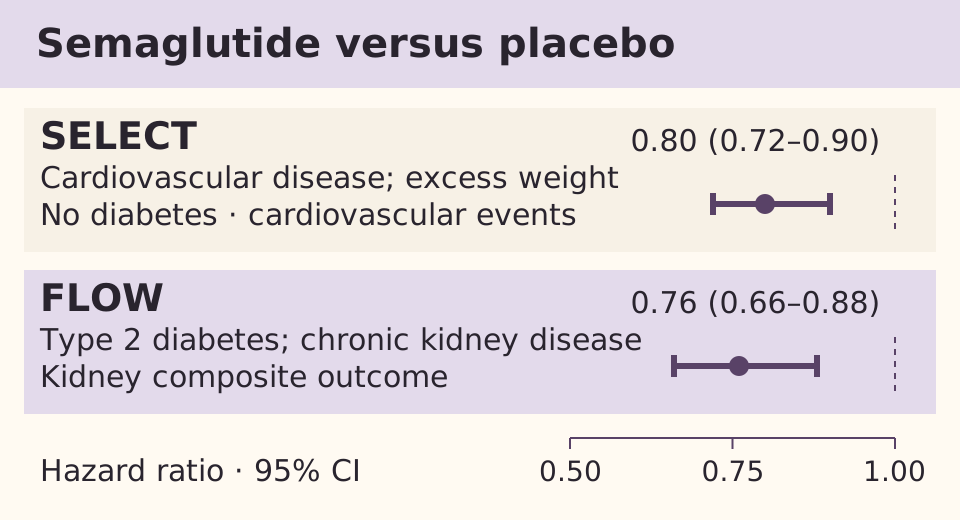
SELECT events; FLOW kidney composite
SELECT enrolled 17,604 adults with established cardiovascular disease and overweight or obesity, without diabetes. Semaglutide reduced the combined outcome of cardiovascular death, nonfatal heart attack or nonfatal stroke compared with placebo: hazard ratio 0.80, with a 95% confidence interval of 0.72–0.90. This is a trial that counted serious events.
FLOW studied 3,533 adults with type 2 diabetes and chronic kidney disease. Its combined outcome included kidney failure, a reduction of at least 50% in estimated kidney filtration, or death from kidney or cardiovascular causes. The hazard ratio was 0.76, with a 95% confidence interval of 0.66–0.88.
A hazard ratio compares the rate at which an event occurs over follow-up; below one favors semaglutide in these comparisons. The confidence intervals describe uncertainty around the estimates. I trust SELECT and FLOW more than a general assertion of metabolic health. Their populations and combined endpoints still belong beside the figures.
Weight changes in STEP 1; SURMOUNT-5
In STEP 1, adults with overweight or obesity without diabetes had mean body-weight changes of −14.9% with semaglutide and −2.4% with placebo at week 68. That is the change within each study group, with its own starting weight.
The SURMOUNT-5 direct comparison found mean changes of −13.7% with semaglutide and −20.2% with tirzepatide at week 72 in adults with obesity. A direct trial gives the comparison a firmer footing than lining up separate studies. Its weight result also has a different purpose from SELECT’s cardiovascular endpoint.
The weight figures initially seem the easiest way to rank these treatments. My preferred comparison starts by naming its intended outcome. The strongest weight comparison cannot answer a kidney question on its own.
Semaglutide gastrointestinal tolerability
The safety review found predominantly mild-to-moderate, transient gastrointestinal effects and an increased risk of gallbladder or biliary disease. Acute pancreatitis remains a class warning. The review could not draw definitive conclusions about rare pancreatic and thyroid-cancer signals because the events were uncommon. The thyroid tumor warning has a rodent basis; human uncertainty needs to remain visible.
Community accounts mention quieter food thoughts, earlier fullness and improved glucose readings, alongside nausea, bowel changes, reflux, fatigue and hair shedding. These are anecdotal accounts, not clinical evidence. They cannot establish a symptom rate or show what caused an individual change. Those unpleasant stories interest me, despite their inability to substitute for a controlled comparison.
Semaglutide is a prescription medicine with approved uses. The clinical record concerns particular formulations, indications and study populations. Personal treatment decisions require an assessment of existing illness and other medicines. That assessment is the part of prescribing I cannot get from the trial averages: a licensed U.S. clinician decides whether to prescribe semaglutide at mypromise.com, the site for Promise Peptides. Some people will not qualify, and compounded semaglutide is not FDA-approved. The retatrutide report shows how much more remains open for an investigational compound.